RimWorld Concord
Deep dive

How Concord works

Language models are good at choosing and explaining. They're bad at being trusted with authority. So Concord gives them neither the game nor the database. Each mind gets a narrow view, a menu of real options, and a structured reply. Everything that matters is decided and checked underneath.

The system map

Two paths into one game. The character path runs through the coordinator, where consent and memory live. The player harness is a separate, narrower path that a benchmark controller uses today and the core is meant to take over in phase 2. On both, authority flows downward only as validated actions, and truth flows upward as observations and receipts.

Concord architecture Model minds at the top: colonist minds, the core planner and the optional Jev appraisal receive perspectives and return validated choices to the TypeScript coordinator with SQLite, which handles perspectives, consent and agreements, attention, the core scheduler and checkpoints. A benchmark controller instead uses the player harness through MCP tools: observe, look, act and time. Both reach the C# Concord mod inside RimWorld through a lab bridge. The mod opens tagged native intents, runs the remaining ordered jobs, hooks game events, exports player-visible perception, applies player-equivalent harness actions with narrated receipts, and returns receipts. RimWorld's own work givers, zones and reservations carry out the work. MINDS · replaceable Colonist minds one tool-free call per decision Luna · Claude · scripted Core planner propose · counter · ask · wait silent when nothing changed Fast appraisal Jev: is this worth a thought? optional; not in recent runs Benchmark controller Codex agent, fresh context per arm phase 2 B: the core takes over validated choice perspective + menu MCP tools COORDINATOR · TypeScript + SQLite Perspectives & consent owner-only views, real menus identity-bound decisions counters → fresh offers intents: quota, helper credit Attention & the core event routing per pawn coalescing, pacing event-driven core wake failures counted per lane State & checkpoints characters, outlooks, audit epochs, action IDs paired save + state cold restore PLAYER HARNESS observe digest + changes look queries, placement check act player controls only time pause, speed no draft · no direct jobs bypasses the coordinator intents + actions (with IDs) events, receipts (with ticks) acts ↓ receipts ↑ CONCORD MOD · C# inside RimWorld, lab-only Action bridge+ saved ledger Harmony hooksjobs, meals, placements Observer+ crew log tab Native intents: tagged stockpiles ordered: move, rescue, build, cook, eat Harness: perceive + act narrated, receipt-backed RIMWORLD work givers, zones, bills, blueprints, reservations, native jobs, needs, pathing
decides or proposesenforces and remembersexecutes and observesthe game, unchanged
02 · Knowledge boundaries

Who knows what

Each mind gets a scoped perspective; the core uses an explicit allowlist rather than receiving pawn or character state wholesale. A colonist sees its own traits, skills, exact needs, surviving memories, its own history and a private outlook of up to four revisable notes, each tied to its own experiences.

The core receives explicitly shared information: addressed messages, agreement receipts, grounded opportunities, attributed local food/campfire sightings, and shared-link Food/Rest telemetry (urgent, low, satisfied, unknown) with a timestamp. Telemetry is not a visual observation. Stale readings become unknown, never zero, and the core view distinguishes observation ticks from event/receipt times.

What the colony has built (stockpiles, blueprints, bills) is colony-public, because someone placed it on the map. Loose things stay attributed sightings: a native work scan seeing the whole map is not permission to put unobserved resources in a model's menu.

Coarse bands cross the link. Thoughts don't.

The scope table

InformationThe colonistOther colonistsThe coreYou (crew log)
Exact needs, traits, skillsownnonono
Food/Rest bandsyeslinked peersyesyes
Private outlook & memoriesownnonono
Messages addressed to themyesparticipants onlyif addressedyes
Agreement progress (receipts)ownnoyesyes
Local food/campfire sightingsown sightingsnot automaticallyattributed shared listSupplies tab
Tagged stockpiles (native intents)named in offerson the mapits own intentslabelled on the map
Nearby grounded opportunitiesown shortlistnobounded listno
03 · Native intents

Steer the planner, don't drive the pawn

RimWorld already has an intent layer: the player's controls. Stockpile zones, blueprints, bills and designations are state on the map, and pawns fulfil them through their own work givers, in between eating and sleeping. Concord now uses that layer. An accepted haul becomes a stockpile tagged with its agreement and a quota ("up to 30 wood"), not a stream of orders.

Harmony hooks report job starts and ends, eating and actual placements. Credit comes from placements, per pawn: credited plus reserved never exceeds the quota, and anything else that lands in the zone is counted as incidental, never hidden. The tag sits on the zone, not the wood. Trips already under way before tagging remain ordinary work and get no agreement credit; withdrawal blocks new pickups but lets already-carried cargo finish. A pawn who refused or deferred is excluded from new tagged work; anyone else who pitches in is labelled helping, not asked. When the quota is met, one record retires the agreement and the zone becomes an ordinary stockpile.

The core never sets work priorities, and a pawn who can't do a kind of work is visibly not offered it. The loads are strict: one source per trip, no extra pickups on the way; a growing hold is parked after it failed to come through two fix rounds cleanly.

mod/NativeIntents.cs · mod/IntentPatches.cs · src/native-intents.ts · docs/NATIVE_INTENTS.md · docs/MIGRATION_HAULING.md

The intent is state on the map. Receipts decide the credit. Illustrative sequence, not a replay: the final 35/40 split is from the live spike; the meal interruption demonstrates separately scripted behaviour.
The life of a native haul intent An offer goes only to pawns who can do the work. A fresh acceptance opens a stockpile tagged with the agreement and a quota. Refusal or not-now excludes that pawn from new tagged work; pre-tag trips remain ordinary work; an answer after the work is done lapses and starts nothing. While the stockpile is open, a quota ledger credits placements per pawn, agreed pawns and unasked helpers separately, and never lets credited plus reserved exceed the quota. Meals and sleep interrupt, but the intent stays on the map and work resumes through the game's work givers. Once the quota is met from placement receipts, one record retires the agreement and the zone becomes an ordinary stockpile. Offered to pawns who can do it Accepted fresh yes, one pawn Tagged stockpile open · "up to 75 wood" Quota met from placements Retired ordinary stockpile refuse · not now no new tagged work yes after the work is done lapses, starts nothing QUOTA LEDGER credited + reserved ≤ quota, credit per pawn Beatrice 35 · agreedPedro 40 · helping, not asked other placements in the zone: incidental, counted the tag is on the zone, not on the wood MEALS, SLEEP the intent stays on the map; work resumes natively scripted: 3 ticks after Credit split from the first live native haul, 24 Sep 2026. Only Beatrice had agreed; Pedro's offer arrived after he had started helping.
decided by a pawnenforced from receiptscarried out by the game
04 · Player harness

Play like a player, minus the mouse

The core kept failing to turn available opportunities into action. Its narrow view is a strong, testable explanation, though not a proven sole cause: no campfire, no beds, a medical alert and 120 wood by the wall were all things a player could see and it couldn't. So phase 1 asked a plainer question: can an agent run the colony better through a structured interface than through the human UI?

The harness reads what a player can read: one coherent snapshot per read with stable IDs, a byte-bounded digest with a change marker, and queries such as a placement check that uses the game's own build designator. Hidden weather schedules, fogged cells and storyteller plans stay out. It acts through what a player can use: blueprints, designations, zones, bills, work priorities, schedules, forbid and allow, area restrictions, bed assignment and time controls. No drafting and no direct pawn jobs; the game's own work givers do the work.

Every action returns an acceptance receipt or refusal reason, identifying whether it came from the game or harness validation. An accepted blueprint is not a built campfire, and assigning a bed is not sleeping: completion is read later from game state. Since phase 2 A, each accepted edit also writes one narrated record naming the core as decision-maker, never an invented pawn agreement. That narration is scripted-tested with zero model calls; the sealed viewer-legibility test is still ahead.

src/harness/ · trials/harness-mcp-server.ts · trials/ui-mcp-server.ts · mod/Perception.cs · mod/HarnessActions.cs · mod/HarnessNarration.cs · docs/HARNESS.md · docs/PHASE2.md

Accepted is not built. Illustrative. The narrated lines match the mod's wording; the refusal reason is the one recorded in the phase 2 A scripted check.
Phase 1 benchmark: controller wall time, harness versus UI Nine matched pairs, all eighteen arms completed their frozen task. Median controller wall time: T1 58.7 s harness versus 106.6 s UI; T2 68.7 versus 217.3 s; T3 41.0 versus 240.4 s. The harness arm was faster in every pair. 01 min2 min3 min4 min5 mincontroller wall time per arm, including start-up and inference Harness armUI arm (screenshots, clicks, keys) T1 · campfire and meals median 58.7 s harness · 106.6 s UIpair 1T1 pair 1, harness arm: 59.5 s controller wall time; task completedT1 pair 1, UI arm: 106.3 s controller wall time; task completedpair 2T1 pair 2, harness arm: 53.7 s controller wall time; task completedT1 pair 2, UI arm: 106.6 s controller wall time; task completedpair 3T1 pair 3, harness arm: 58.7 s controller wall time; task completedT1 pair 3, UI arm: 107.5 s controller wall time; task completedT2 · fed and assigned beds median 68.7 s harness · 217.3 s UIpair 1T2 pair 1, harness arm: 68.7 s controller wall time; task completedT2 pair 1, UI arm: 247.4 s controller wall time; task completedpair 2T2 pair 2, harness arm: 73.4 s controller wall time; task completedT2 pair 2, UI arm: 153.3 s controller wall time; task completedpair 3T2 pair 3, harness arm: 58.8 s controller wall time; task completedT2 pair 3, UI arm: 217.3 s controller wall time; task completedT3 · wood inside median 41.0 s harness · 240.4 s UIpair 1T3 pair 1, harness arm: 43.3 s controller wall time; task completedT3 pair 1, UI arm: 312.4 s controller wall time; task completedpair 2T3 pair 2, harness arm: 37.3 s controller wall time; task completedT3 pair 2, UI arm: 240.4 s controller wall time; task completedpair 3T3 pair 3, harness arm: 41.0 s controller wall time; task completedT3 pair 3, UI arm: 205.4 s controller wall time; task completed
Harness vs UI: controller wall time. Nine matched pairs, alternating order, the same save and task within each pair, and the same controller model; all 18 arms met their frozen goal. T2 required food and suitable assigned beds, not sleep. Fewer inputs in every pair, too. Colony time showed no consistent harness advantage on T1 or T2; T3 finished earlier in game time through the harness, with plan, recovery and command size all contributing. Billed dollars were unavailable on the route used. T1 table · T2/T3 tables
05 · Model minds

Small views, real menus, no tools

A decision is one bounded call. The model gets its perspective, where every need says what its scale means, plus a menu of executable choices with their effects spelled out. Contextual schemas constrain choices and supplied IDs where supported; runtime validation still checks every reply. Counterproposal actions have additional execution-time checks. Shared instructions are supplemented by relevant action and knowledge contracts.

The Claude route runs with no tools, no MCP servers, no plugins, and checks that at start-up before every call. Every trial has a durable attempt ledger and no rerolls. Failures keep their reserved attempt and a bounded diagnostic stage. Backends are swappable: scripted, Claude, Luna (now the core and pawn model in continuous play) and Jev for fast appraisal. A failed request records its cause, including prompts that are too large before any model is called.

src/model-perspective.ts · src/reflection-choice.ts · src/claude-decision.ts · src/decision-trials.ts

Need, as the colonist sees it{ name: "Food", known: true, fractionFilled: 0.4, percentFilled: 40, meaning: "0 = empty/starving; 1 = full/well fed. Higher is LESS hunger." }
A choice, as it's offered{ choice: "counter", effect: "Suggest different implemented work; execute nothing. Adoption requires another offer and fresh consent." }
Why this shapeAn early cheaper-model check refused a job over "severe hunger" while Food read 0.9. The fix went into the data, not a longer prompt.
06 · Attention and time

Three speeds of thought

In continuous mode, native habits such as eating, sleeping and ordinary jobs can continue while a colonist deliberates, with a thinking badge over their head. Explicit inference pauses stop simulation. Fast appraisal decides whether an event deserves a thought (bounded live trials so far; not in recent runs). Deliberation handles negotiation, reconsideration and planning.

Native events are archived and routed only to the pawn who experienced them. Repeated signals coalesce, health events bypass cooldowns, and mundane chatter waits instead of cancelling a thought in progress. Reflection pacing spreads thinking over the observation window. Failures are counted per lane (core, decisions, answers, reflections), so a success in one lane can't hide repeated failures in another, and oversized reflection views are trimmed oldest-first rather than raising the limit. Play is continuous by default; pausing at decisions is an explicit test mode.

src/routing.ts · src/attention.ts · src/reflection-pacing.ts · mod/Awareness.cs · mod/DecisionPause.cs

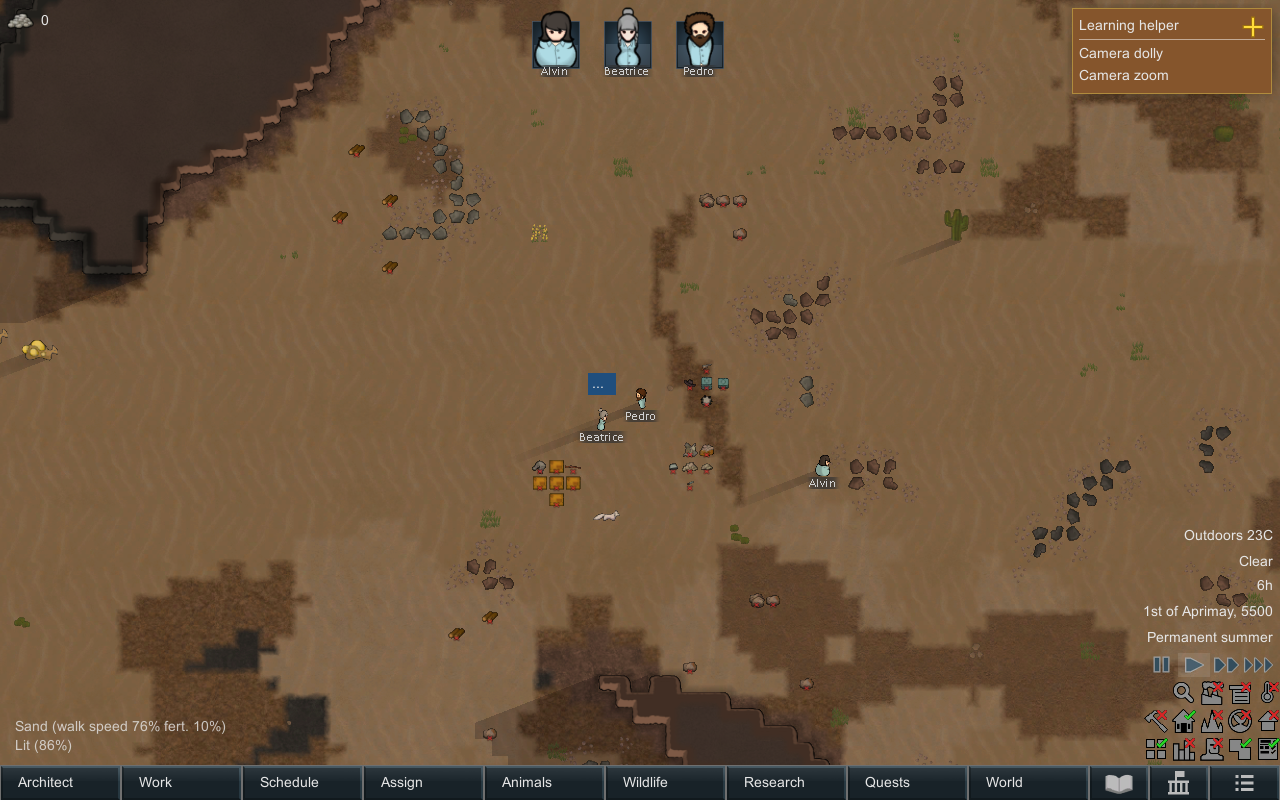
Thinking badgeearly scripted trial
RimWorld map with a small blue thinking badge above a colonist who is deliberating while the colony keeps moving.
07 · The core

A planner that waits to be needed

Each core turn picks one of four moves: propose a listed opportunity, adopt a counter for fresh consent, ask one pawn one question, or wait. It keeps up to eight sourced topics marked open, blocked, deferred, resolved or declined. "Resolved" requires completed linked work, so its prose can't close a topic that the receipts don't close.

It wakes on public changes: finished or stopped work, requests, messages, answers, and native-intent milestones or stalls. Opportunity churn alone does not wake it. A shared status band changing on its own, with no offerable opportunity or counter, is handled silently, with no model call and no crew-log entry, just a "waiting on…" status line, unless Food or Rest reaches urgent (including a first or previously unknown reading). Private needs do not wake it. After an explicit wait while work remains offerable, at most two bounded reviews are allowed (2,500 ticks, then 5,000); otherwise idle time stays silent. A wait never writes to the log. Messages published after newer receipts carry an "as of" mark. Refused work isn't pushed again; a colonist who said "not now" can invite exactly one fresh offer.

src/core-planner.ts · src/core-scheduler.ts · mod/SharedStatus.cs

Public events wake it. Status-only changes wait quietly unless work is offerable or someone turns urgent.
08 · Timeline safety

Saves, reloads and slow thoughts

Model calls take seconds; players save, load and rewind. Every loaded game gets a fresh epoch, so an answer from before a reload can't act in the new timeline. Each accepted action gets an ID before dispatch, and the game's saved ledger makes a duplicate a no-op.

Paired checkpoints save the paused game, hash it and store the matching character state together. Restoring checks the hash and forks the timeline. Gameplay reports distinguish paired restore from a cold coordinator restore: a new coordinator process (not necessarily a game restart), with retained results and no extra model calls. Some experiments left restore gaps; offline checks do not demonstrate native persistence.

src/store.ts · src/lab-bridge.ts · mod/Concord.cs

Old answers can't reach into a new timeline.
09 · Evidence culture

Every claim has a receipt

  • Scripted game tests for every mechanic, including refusal, withdrawal and restore.
  • Frozen live trials, setup signed up front, no rerolls, failures kept, recorded uncut and read cold before any technical findings are released.
  • Three gates per migration: an internals note from the game's own assemblies, a signed design before code, and a verdict after runs.
  • Offline snapshot banks: the same situation, varied one thing at a time, across models.
  • Offline typed-claims prototype that distinguishes submitted facts, forecasts and preferences; it is not a production truth checker.
  • Uncut recordings: the first native haul, the hauling migration's first run and Gate C rerun, a pipeline regression, ten minutes of choosing to eat and a scripted harness-actions check.
  • Independent code review on every nontrivial PR and fact-checked diary entries for selected milestones.

Well-formed output and grounded understanding are measured separately. Passing the schema doesn't count as understanding.

docs/EVALUATION.md · docs/trials/ · docs/evidence/

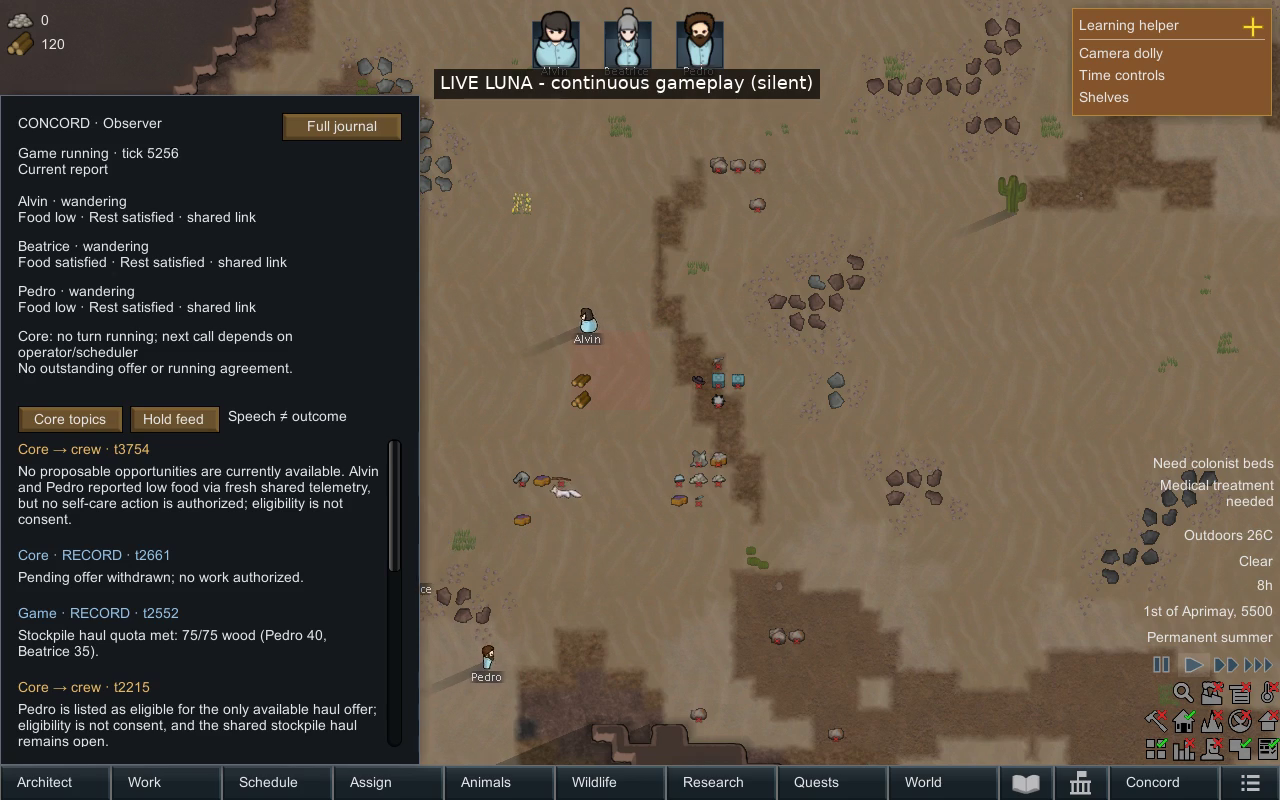
Concord · observerlive native haul · 24 Sep 2026
The Concord observer during the live native-haul run. The journal shows the game record 'Stockpile haul quota met: 75/75 wood (Pedro 40, Beatrice 35)', then 'Pending offer withdrawn; no work authorized', then a core message that nothing can be proposed. The colony wood counter reads 120.
The quota closes from placement receipts. The "withdrawn" line below it is a real defect, kept on the record: Pedro had said yes after the work was done. The counter later reads 120; post-retirement hauling is recorded, but the exact quantities and destinations of the remaining 45 are unknown.
Research tree

What's built, what's next

Status as of 27 September 2026. "Verified slice" means bounded evidence for the named capability, not proven long-run reliability. Labels are qualitative, not completion percentages.

Phase 2 runs in an agreed order: A, legible harness actions and a tending/roofed-sleep task (T4); B, the core becomes the harness agent, after its public knowledge boundary is written down, tested in a frozen ten-minute scene and a T1–T4 regression; C, offers and binding refusals come back on top. Current plan and evidence →

verified slicepartly therenot started

Foundation

Consent protocolidentity-bound proposals, accept / refuse / counter / not now; late answers lapse
State & auditSQLite characters, commitments, ordered audit trail
Timeline safetyepochs, action ledger, paired and new-process cold restore
Isolated model routetool-free character calls, no rerolls, failures counted per lane
Observer & recordingscompact public sidebar, uncut ten-minute recordings

Minds & core

Self-perspectivestraits, skills, needs, memories, relations
Private outlookup to four revisable, sourced notes
Live coreevent-driven; asks, follows up, waits silently
Luna in continuous playcore, answers and reflections without a turn cap; grounding mixed
Social exchangemessages work and persist; pawn-to-pawn proposals don't exist yet
Grounded narrationobservation ages and "as of" marks built; stale prose still seen live

Game side

Harmony event hooksjob start/end, eating, placements
Native haul spikelive: 75/75, zero consent violations, unasked helper credited
Hauling migrationstrict hold; game-side live verdict passed; growing hold parked
Pawn-owned eatingchosen by the pawn, never ordered; live-verified
Harness action recordsnarration and bed assignment scripted-tested; sealed viewer read pending
Player harness benchmarkT1–T3: 18/18 arms met their goals; less wall time in every pair

Beyond

Multi-step plansa controller builds then cooks in T1; the in-world core hasn't yet
A scene worth watchingcontinuous ten-minute runs; no plan between colonists yet

Known gaps, stated plainly

A successful benchmark is not yet a watchable crew. Eighteen scored arms completed three frozen tasks. The isolated player controller can build and cook, but the in-world core has not yet been integrated with that harness. No new integrated multi-step scene or binding-refusal trial is claimed.

The old native-haul verdict is complete, not pending. The game-side migration passed, while missing character conflict and narrative weaknesses remain explicit. The ordered hauling runtime was retired; the separate construction-consent slice is retired unmerged, with its partial evidence retained. The agreed phase-2 plan now governs what follows.

What comes next is measured separately. Receipt-backed action narration has scripted/UI evidence, not a sealed four-of-five viewer verdict. T4 still needs completed-tending evidence and simultaneous actual sleep under roofs. Public-core knowledge limits and a versioned, opt-in annotation join precede the core integration; pawn-private views remain separate.

Hauling runs strict. The growing hold, which would keep RimWorld's extra pickups within the quota, is parked after its two fix rounds; the in-game clock is verified on one map only.

Character continuity is early. Outlooks form, persist and show up in later reasoning. Whether they add up to stable personalities over a long game is an open question.

It's a lab build, not a player download. The mod only activates in a configured lab environment.